Welcome to my research site! Here you can read about my research, publications, and experiments I am conducting at Jefferson Lab. My experiments use high-energy electron and photon scattering to study the strong force in nuclei so that we can understand the connection between partonic and nucleonic degrees of freedom, the role of QCD (color) effects in the nuclear medium, fundamental interactions of nucleons in nuclei, and more. If you find my research interesting, please contact me and learn about how you can get involved!
Research
Search for Color Transparency
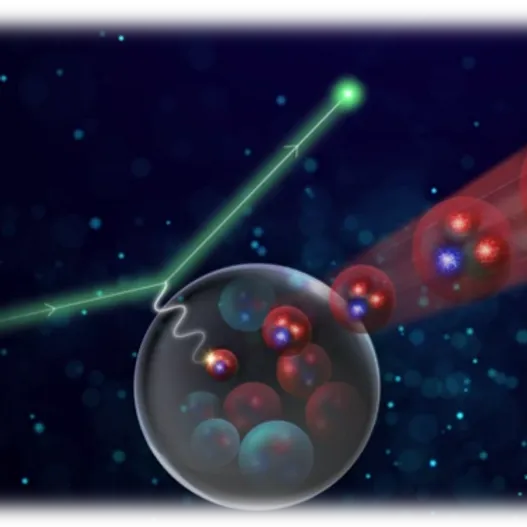 Jefferson’s lab electron beam energy is well-suited for exploring Color Transparency phenomena, i.e. hadrons with quarks in a small, transverse size configuration that reduce their strong interactions in nuclei. Color Transparency lies at the cross roads between descriptions of the nucleus involving quarks and gluons and descriptions involving nucleon interactions.
Bound nucleon structure modifications
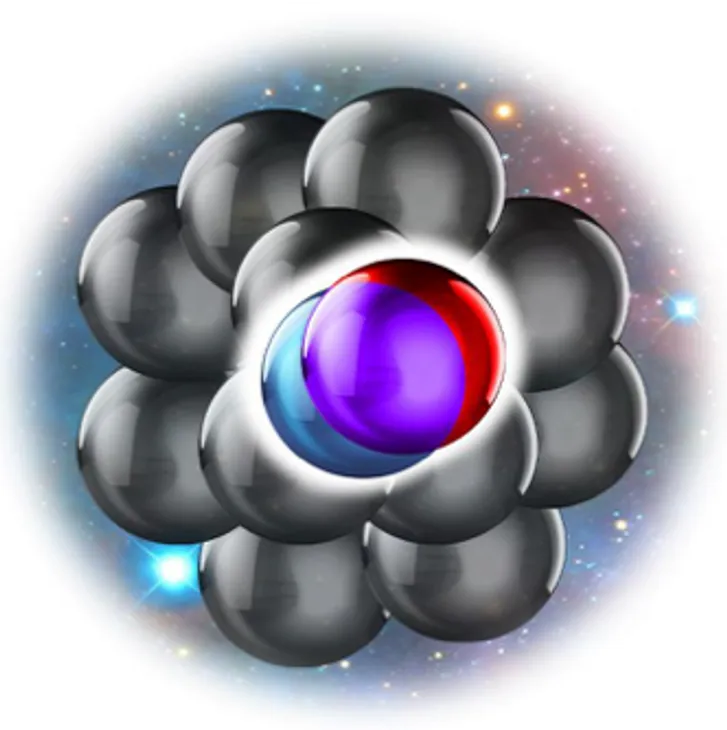 Nuclei are fascinating laboratories to study the strong nuclear force as it is propagated via gluons inside of protons and neutrons and leaks out to bind a nucleus together. Amazingly, the quark structure of protons and neutrons changes when they are bound in a nucleus, and this has yet to be fully explained. Many studies point to local density effects in the nucleus and connections to nucleons at short-distances.
Detectors, optics, and readout research
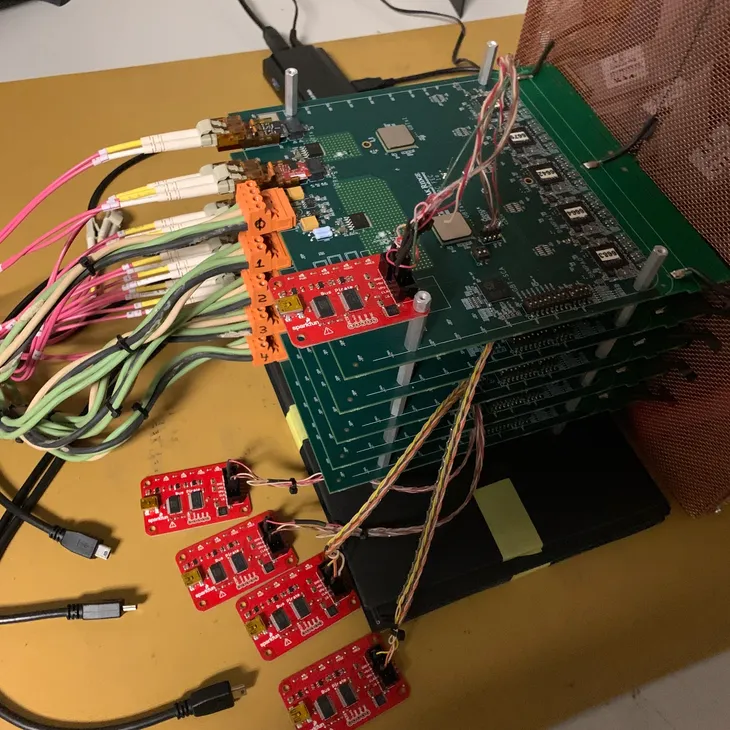 Detectors are used to readout particle energy and momenta in experiments and merit new research and development to keep up with the increased demand for higher rates, improving experimental signal-to-noise, and utilizing improved electronic readout components. Having built an electromagnetic calorimeter for dark sector physics, tested region II drift chambers for the CLAS12 installation, extensively tested, improved, and supported gaseous electron multiplier (GEM) detectors for readout in high rate Hall A & C experiments, and developed the optics reconstruction and evaluation of the HMS and SHMS Hall C spectrometers in the 12 GeV era, my interests are currently focused on improving the readout electronics that can facilitate faster and trigger-less readout.
ePIC software development
 ePIC is the next detector under development for the electron-ion collider which will lead the future frontier in nuclear physics at Brookhaven in the late 2030s. I serve as the Deptuy of Operations for ePIC Software development. Software supports the heart of experiments, and I support the initiatives of Production, User Learning, and Validation for an international community user developers. See our landing page to join.
FIU nuclear group